Thursday, March 15, 2012

Form and Function

What a glorious first day of our spring session! We couldn’t have asked for more beautiful weather. We saw some unexpected signs of spring!

We kicked off our session, which is called “Amazing Adaptations” with a class all about Form and Function. Throughout class we learned examples of how the shape or form of a living thing can relate to its function and how it survives.


Our outside game was called “Quick Frozen Critters” and we played with Homeschool 2. It was a game all about predators and prey – in this case, coyotes and cottontails. There were two coyote predators and the rest of the children were cottontails. No matter the animal, everyone had to collect enough food to survive. It was a great way to start thinking about how to survive in the wild!

For greeting, homeschoolers were given a piece of a defense puzzle with a picture of a living thing on it. They had to find their match, then figure out what they had in common with their match. For example, even though the nettles and the yellowjacket are different creatures, both defend themselves by stinging. In this way, we began to think about how form and function are connected.


We met Diana, our intern from Mount Holyoke who will be joining us this session. We are so glad to have her!

We sang the alligator song, a fun repeat-after-me with hand motions and silly words.


We compared a branch of a barberry bush to a branch of a burning bush. One had sharp thorns and the other had stiff winglike structures. How could the forms of these plants help the plant function? 

 
 Our morning activity was called “Seeing Function.” To practice observing the functions at work in living things, we began by describing them using adjectives (our password of the day!). In pairs, one child was blindfolded and held a natural object in their hand and described what they felt. The other child took note of the adjectives they were using. Then as a group we guessed at what function these adjectives could be achieving. For example, a feather was lightweight, which Penelope suggested was helpful in a bird’s flight.


After snack, we took a look at the next activity: a function scavenger hunt. Instead of going outside to look for objects, we were going to look for functions. It wasn’t easy, but kids opened their minds to find examples such as nature cleaning itself, nature transforming waste, and communication in nature!


Best of all was seeing the new signs of spring everywhere: 

skunk cabbage

 winter aconite

 snow drops

 Wood frogs mating in the vernal pool 


 We had a wonderful lunchtime outside at the picnic tables then came in for journal time. Kids had to pick an object from the nature table, list an adjective describing it, then guess at some possible functions linked to those adjectoves. For example, there was a hard, spiral shell that would be good for protection against predators.

Then Diana and I put on a play about insect adaptations. Turns out insects are fabulously adapted for survival!


Please wear camouflage clothing for next week! We will be talking about how camouflage is an adaptation and trying it out ourselves.


Monday, February 6, 2012

How Can Snow Be An Insulator?

 
Wow.  We had such an amazing day today. It was beautiful springlike weather, which didn’t lend well to our theme – “Under the Snow” – but it did make for a gorgeous day of playing the forest and learning!

We joined the older homeschool group for a game of lizard tails to start off the day. Then we came inside and began morning circle with “snowball” greeting, where kids picked names from a basket and greeted the person they picked.

Kids had great home projects to share – photos and stories of animal tracks and sign in the snow and grass.


We discussed our theme, and the fact that since we didn’t have any snow to explore, we’d have to get creative. We talked about how the snow can be like a blanket, even though it’s cold, and how it can also protect animals from their predators. 


Our morning activity was making Borax crystals – an idea from Carole, Connor and Owen. To make them, we made shapes out of pipe cleaners and then dipped them into a jar that had a solution of Borax and water. We should have crystals in two days!

 
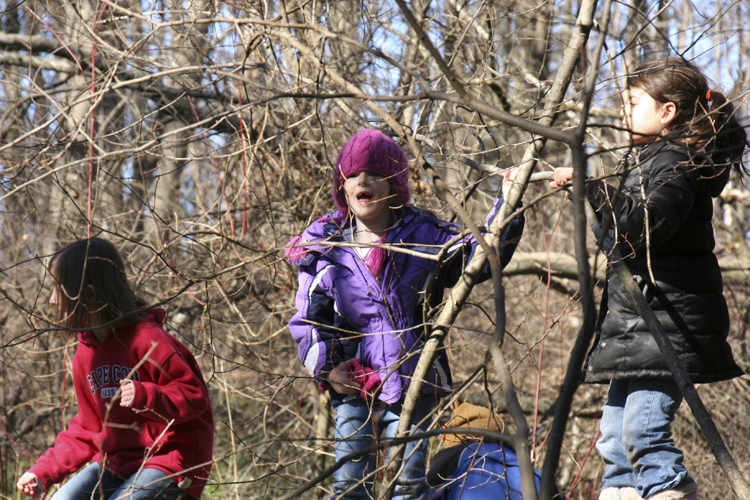
We ate snack and then we were off. We ran, not walked, to the frog pond to look for frogs and climb trees. What a great “playground” that is! We did spot a frog – can you believe it?


 Then we ran, not walked, through the forest, eventually arriving at the farm. We looked for snakes, gathered cattails and admired the view. We counted seven praying mantis egg cases today and saw other cool stuff – like a small animal’s guts and two red-tailed hawks! 


We think we found some signs of a yellow-bellied sapsucker – they have very distinct pecking patterns on dead trees.


We ate lunch and recapped our passwords this session – conifer, metamorphosis, hexagon, scat, and ... today’s password was a mystery we hadn’t solved yet. Then I read a book Penelope had written about some snowy owl friends. It was awesome!


Kids finished their journals today – we had a secret code to break to find out our password and what it meant. Our password for the day was subnivean and it means “under the snow”. We bound our journals – they came out beautifully.


Then I put on a play called “Snug in the Snow” about two mice under the snow. A weasel almost came to eat them but they were safe... for now. We learned that animals under the snow have all they need: food, warmth and shelter. Plus miles of tunnels to run through!


We finished the day with a science experiment. We used toothpicks and water to “magically” form a five-pointed star. Amazing! (It’s not magic, but how did it happen?) 


 Our Borax crystals should be ready to pick up in two days, so feel free to stop by and pick yours up. Also, now is the time to sign up for spring homeschool so please call and register! See you in March!